
Translation Links
Français (French) Cliquez sur le lien pour la traduction en français :
انقر على الرابط للاطلاع على الترجمة العربية
NIHA- BATROUN, LEBANON
Intoduction to the Name
- On the meaning of a name, and the place that carries it
Niha is a name of ancient Syriac origin. It is understood to carry several connected meanings including Peace and Quiet — each one a quiet reflection of the village’s character and the spirit of its people.
Lebanon is home to several villages bearing this name — an uncommon occurrence in a country where place names are typically distinct. This shared name is most plausibly explained by patterns of internal migration: communities that relocated from one region to another carried their original village name with them, preserving it as an expression of identity, memory, and continuity.
The villages sharing the name Niha are found across Lebanon’s diverse regions:
- Niha – Batroun North Lebanon (this village)
- Niha – Zahle Bekaa Valley
- Niha – Chouf Mount Lebanon
- Niha – Tyre South of lebanon
Among Lebanon’s approximately 1,600 villages and cadastral units, no other name repeats four times across the full north-to-south extent of the country,at the most there are only a few villages names repeated twice in Lebanon When mapped together, the four villages trace Lebanon’s mountainous backbone — all four sitting within a narrow elevation band between 900 and 1,200 metres, all near ancient springs, all on documented ancient transit routes, and all with confirmed sacred architectural heritage predating the Arab conquest.
The village addressed throughout this website is Niha – Batroun, located in the Batroun District of Lebanon’s North Governorate —The regional qualifier is used as a matter of convention to distinguish it clearly from its namesakes.
A name carried across centuries and landscapes — each village a testament to the enduring bond between a people and the place they came from

Welcome message
- A new chapter in Niha’s governance and development
Niha established in 2025 its first elected Municipal Council — a landmark moment in the village’s modern history, and the foundation for a new era of transparent, community-led governance and sustainable development.
The new council brings with it a clear and enduring commitment: to lead Niha with integrity, to protect what has been inherited, and to build with purpose toward what comes next. Its founding principles reflect both the values of the village and the ambitions of its people — at home and across the world.
Transparent leadership
Accountable, open governance grounded in community trust
Sustainable development
Rural growth that respects land, culture, and future generations
Heritage protection
Preserving Niha’s archaeological, spiritual, and architectural legacy
International cooperation
Partnering with diaspora communities and global institutions

Flagship Initiatives Delivered
Niha has demonstrated strong delivery capacity through successful flagship initiatives implemented through municipal coordination and diaspora support:
- Greening and Beautification Program (Ongoing 2026)-Ongoing cedar planting and landscaping works reinforcing village identity and environmental resilience. In January 2026, the municipality successfully planted 150 street trees along the western entry road into the village from Kfour as part of program 1
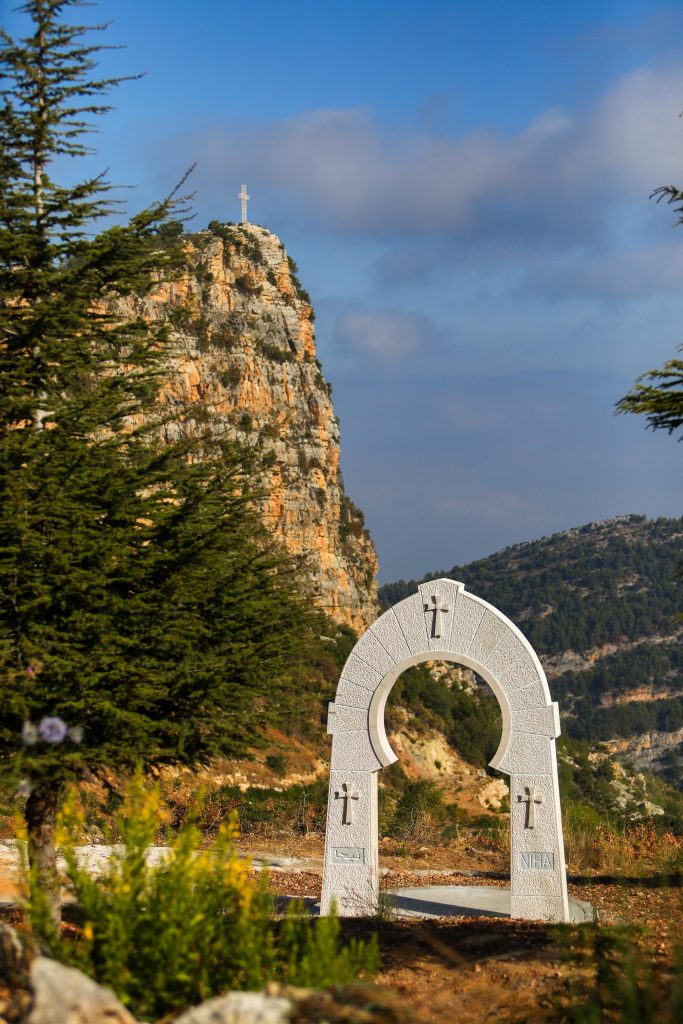
- Abrahamic Gate – Multicultural Heritage & Migration Memorial (Completed 2026)-A contemporary sculptural landmark at the entrance of Niha, designed in Sydney and realised by local artisans. The monument symbolises Niha’s historic Abrahamic heritage and commemorates migration journeys of diaspora communities worldwide.
- Water Infrastructure Development (Completed 2026)– Construction and drilling of a subsurface water well to a depth of 150 meters, pumping systems/motors with power generated by 21 solar panels, construction of holding water tank 160,000 litres and distribution infrastructure/piping to strengthen drinking water supply and agricultural irrigation.
- Renewable Energy Deployment (Completed 2023)– Installation of decentralised solar systems supporting street lighting and residential energy resilience.
- Community Hall and Residential Facility (Completed 2022)– A 200-seat community hall and accommodation facility fully funded by diaspora patronage, supporting cultural events, municipal meetings, and civic functions.
- Cedar Scent Lodge – Eco-Tourism Facility (Completed 2021)– A nature-based eco-accommodation facility within the cedar forest landscape supporting tourism and outdoor events.
Website: www.cedar-scent.com/en
The Village of Niha – Batroun
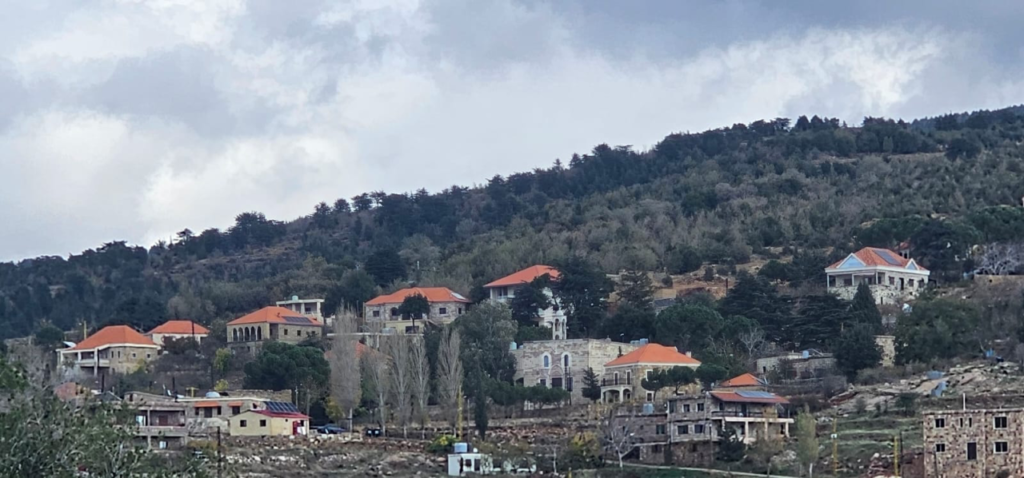
- A small alpine village of deep heritage, set high in the mountains of northern Lebanon
Niha is a small, nestled within the steep mountain ranges of the Batroun District, in Lebanon’s North Governorate. It forms part of the Mount Lebanon mountain chain — one of the defining geographical features of the country — and sits at an elevation of approximately 1,450 metres, with surrounding peaks reaching 1,860 metres above sea level.
The village is home to one of Lebanon’s largest surviving cedar forest areas, the celebrated Arz Niha woodland, and is renowned for its mild, highly sought-after mountain climate — qualities that have drawn visitors, pilgrims, and returning diaspora families for generations.
- 1,450m – Village elevation
- 1,860 m – Surrounding peaks
- 75 – Occupied houses

Character and landscape
Niha is celebrated for the breadth and quality of what it offers — a rare combination of natural splendour, living history, and authentic mountain character that few villages in Lebanon can match.
- Cedar forests
- Expansive Arz Niha woodland — one of Lebanon’s most significant surviving cedar landscapes
- Mountain vistas
- Panoramic viewpoints across the valleys of northern Lebanon and, on clear days, to the coastline
- Sacred heritage
- Ancient Christian worship sites spanning from early centuries Preserved stone buildings and winding mountain pathways reflecting centuries of rural Lebanese life
- Hiking and nature
- Mountain trails through cedar forest and alpine terrain attracting walkers and nature visitors year-round
- Agriculture and produce
- A living farming tradition centred on herbs, wild zaatar, seasonal vegetables, and dairy
Over two centuries of emigration, Niha’s people have carried their village with them across the world — and across generations, they have continued to return.
Population and faith
Niha is a historically and traditionally Maronite Catholic village — a Christian identity that has shaped its churches, its feast days, its social life, and its relationship with the wider Maronite community in Lebanon and abroad. This faith remains central to village identity today.
In population terms, Niha is modest in size. Approximately 75 houses are currently occupied within the village, and the registered voter roll within Lebanon numbers around 1,000. When the full global diaspora is counted, however, the number of people who trace their roots to Niha rises to an estimated 5,000 — spread across Australia, the Americas, Europe, and the Caribbean.
Religious feast days and pilgrimage traditions
- Five sacred occasions that continue to draw the community — and the diaspora — home
Niha’s religious identity is inseparable from its character as a village. Rooted in Maronite Christian tradition, the annual cycle of feast days shapes the rhythm of village life — marking time, renewing faith, and drawing families back from across the world. For the global Niha diaspora, these celebrations are among the most powerful expressions of belonging: occasions when distance collapses and the village is, briefly, whole again.

THE FEAST CALENDER
- 9 February
Feast of Saint Maroun
Patron Saint of the Maronite Church
Saint Maroun holds a place of singular importance in Maronite tradition, and his feast day is observed throughout the Maronite world. In Niha, the occasion draws the community together in prayer and communal gathering — an annual reaffirmation of the spiritual identity that has defined the village for centuries. This site was also launched on this feast day, 9 February 2012.
- 23 April
Feast of Saint George
Mar Jiris
Celebrated annually on 23 April, the Feast of Saint George is one of Niha’s most significant religious occasions. The day is observed by residents and diaspora families alike, gathering around the village’s oldest standing church — Saint George’s Church (Mar Jiris) — in a celebration of faith, heritage, and communal belonging.
- 15 August
Feast of Our Lady Mary
Saydet Al Qalaa — Assumption of the Virgin
The Feast of Our Lady Mary on 15 August is one of the most important annual celebrations in the Maronite calendar, and in Niha it carries particular resonance. Each year, the village to participate in religious ceremonies, communal meals, and festivities that fill the mountain air with a spirit of reunion. Throughout August, the ancient grotto chapel of Saydet Al-Qalaa — Our Lady of the Fortress, carved into the cliff face — becomes a place of pilgrimage and prayer, drawing the faithful to one of Niha’s most sacred and atmospheric sites.
- 14 September
Feast of the Exaltation of the Holy Cross
Qarn Niha — Horn of Niha
Along the dramatic ridge of Qarn Niha — the Horn of Niha — stands a 15-metre illuminated cross, solar-powered and visible across the region by night, its light extending as far as the Mediterranean coastline. This landmark is the centrepiece of the Feast of the Exaltation of the Holy Cross, The feast commemorates three foundational moments in Christian history: the discovery of the True Cross by Saint Helena, the dedication of the Church of the Holy Sepulchre in Jerusalem, and the recovery of the Cross by Emperor Heraclius in 629 AD. In Niha, the occasion is marked with prayer, gathering, and the lighting of traditional bonfires — a living flame in the mountain darkness, connecting the present to the ancient past.
Together, these annual celebrations preserve Niha’s spiritual heritage, strengthen community identity across generations, and sustain the living bond between the village and its global diaspora. They are not merely religious occasions — they are the moments when Niha most fully becomes itself.
Churches, shrines and sacred heritage
Places of faith, memory, and enduring spiritual significance
Niha’s sacred landscape is extraordinary in its depth and variety. Within this small alpine village stand churches of great antiquity, a cliff-carved grotto chapel steeped in legend, a sculpture born of a remarkable act of diaspora devotion, and a contemporary monument that honours the full complexity of the village’s heritage. Together, they tell the story of a community whose faith has been its most constant companion across the centuries

THE CHURCHS
Saydet Nour — Our Lady of Light
The main parish church of Niha · Constructed circa 1880
Saydet Nour is the heart of Niha’s parish life and one of the village’s most cherished landmarks. The church was built around 1880 under the initiative of Father Gabriel Karam — who sold his own land to fund its construction — an act of personal sacrifice that speaks to the depth of faith that has always characterised Niha’s people.
The building itself carries history within its very walls. The sandstone used in its construction was reclaimed from an earlier church that had stood and fallen on the same site — a continuity of faith expressed not only spiritually but materially, stone by stone. The church stands today as both a place of active worship and a living monument to Niha’s unbroken Christian heritage
Saint George’s Church
Mar Jiris · The oldest standing church in Niha · Est. 18th–19th century
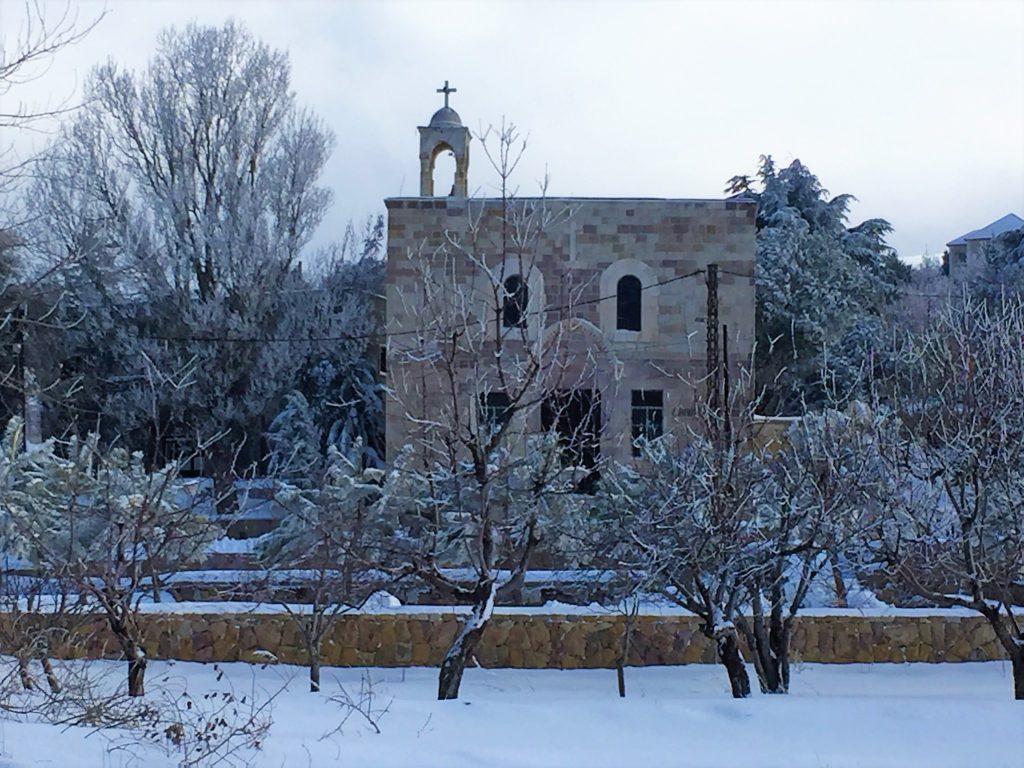
Saint George’s Church — known locally as Mar Jiris — is considered the oldest surviving church in Niha. While its precise construction date has not been formally established, historical evidence points to the 18th or 19th century, making it one of the most significant standing religious structures in the village. The church is the centrepiece of Niha’s annual Feast of Saint George on 23 April, drawing the community and returning diaspora families each year in celebration and prayer.
A story of faith and devotion
The Saint George Sculpture
Nohra Salim and a vow kept across two decades
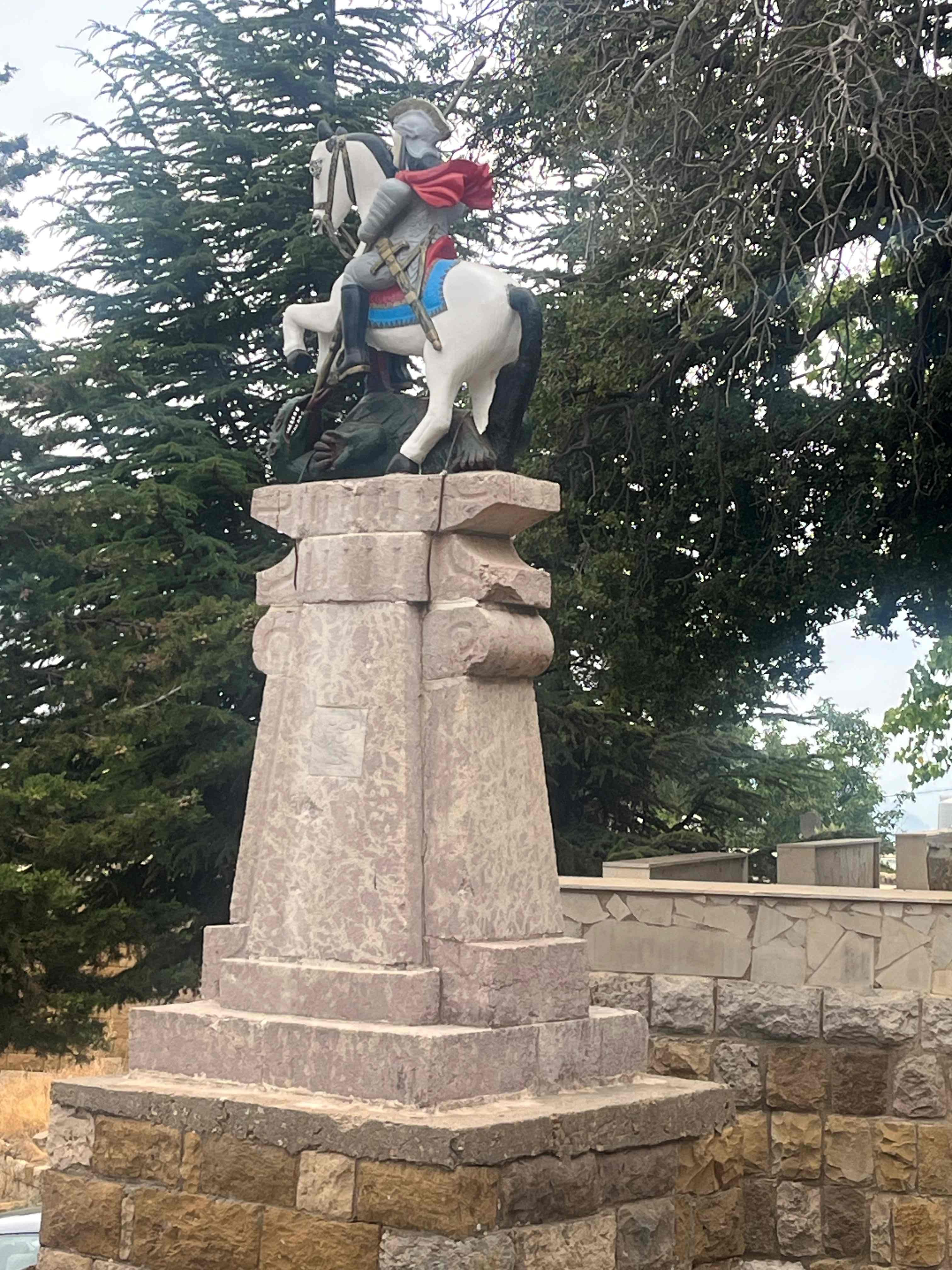
Standing in front of Saydet Nour Church, the sculpture of Saint George is one of Niha’s most powerful landmarks — not only for what it depicts, but for the story of the man who gave it.
In 1935, Nohra Salim left Niha for Cuba, travelling by way of Guadeloupe. Before his departure, he made a sacred pledge to Saint George: that he would set aside one per cent of everything he earned during his life abroad, and one day return it to the village as an offering.
Nohra was never a wealthy man. But he was a man of extraordinary faith and integrity. For seventeen years — from 1935 to 1952 — he honoured his vow without wavering, setting aside his tithe from whatever income came his way. When enough had been saved, he commissioned the sculpture.
The Saint George sculpture is more than a work of art. It is the physical embodiment of a promise kept — a testament to the faith, sacrifice, and enduring love for Niha that has defined its diaspora across generations.
Saydet Al-Qalaa — Our Lady of the Fortress
- Grotto chapel carved into the cliff face · Date of establishment unknown
Saydet Al-Qalaa is among the most distinctive and atmospheric sacred sites. The chapel occupies a natural cave carved into a dramatic cliff face above the village — partly shaped by nature, partly sculpted by human hands — creating a space of extraordinary spiritual character. Part refuge, part sanctuary, it has drawn pilgrims and worshippers for generations, particularly during the month of August when it becomes the focal point of celebrations honouring Our Lady Mary.
At the entrance to the grotto lies a natural water well, fed by springs within the mountain rock itself. Around this well, over many generations, a rich body of legend and oral tradition has accumulated — stories that speak of miracles, ancient connections, and the enduring sense that this place occupies ground where the sacred and the natural world converge. Local accounts also link the grotto to the daughter of an ancient Roman king, said to have brought the Christian faith to the people of the surrounding villages.
The chapel’s exact founding date has not been established. It is one of several sacred sites in Niha that predate written records, their origins preserved instead through oral tradition and collective memory.
The Abrahamic Gate
“Constructed in honour and loving memory of Karam and Mary El Khouri — dedicated by their grandchildren Valerie, Patrick, and Gabriella El Khouri.”
The Abrahamic Gate is both a personal tribute and a broader architectural gesture. It seeks to honour the shared Abrahamic heritage of the region and to express, in built form, a message of coexistence.
The project was conceived as a small but enduring reminder that Lebanon’s history, centuries of cultural and spiritual overlap—between faiths, communities, and people who have long shared the same landscape. In many ways, it is an attempt to return architecture to a deeper truth: that at its foundation, Lebanon’s story is one of shared humanity.
The mountain cliff face that rises above Niha that overlooks the Abrahamic Gate has been a place of sacred return for more than four thousand years. Long before the three Abrahamic faiths took form, this summit was already consecrated — first by Phoenician worshippers who built high-place sanctuaries among the cedar forests, , followed by the Romans who built above the existing Hellenic temple and raised a thirty-column Temple of Mercury at its peak under Emperor Hadrian (AD 117–138), the highest Roman temple in Lebanon at 1,460 metres above sea level. Byzantine monks carved hermitage cells into its cliff face, Maronite patriarchs made it the seat of their Church for over a century, and a canonised saint was born at its foot. It is not a monument placed beside history. It is a monument that grows directly out of it.
Site and Setting
The monument is located at the entrance to the alpine village of Niha in the Batroun district of North Lebanon, set within a 5,000 m² parcel of ancestral family land overlooking terraced orchards and cedar-covered mountains.
Over several years on my return visits, the site was carefully shaped into a landscaped hillside park, with stone terraces and plantings of native cedar and pine—creating a quiet, natural frame for the memorial.
Niha itself carries a remarkable historical legacy, with past inhabitants of Christian, Muslim, and Jewish communities that once coexisted in the region. This layered heritage—rooted in the Abrahamic traditions—became the central inspiration behind the project’s form and meaning.
Architectural Concept
The Abrahamic Gate is conceived as a contemporary sculptural gateway, drawing together references from across Lebanon’s civilisational history.
Architecturally, the shrine’s sculptural form blends ancient devotion with contemporary simplicity— merging stone, light, and nature to express a spirituality that is humble, open, and enduring. Its flowing façade echoes the contours of the cliffs and the silhouette of the cedar tree, while two angled slender stone columns evoke both the entryways of ancient temples. Built of locally quarried stone through traditional craftsmanship, it rises not as an imposition, but as an extension of the land itself.
A Roman-inspired arch is set within a pointed Arabian arch, while a halo motif—borrowed from Byzantine iconography—crowns the composition. Three carved crosses reference both the Christian Holy Trinity and, more broadly, the three Abrahamic faiths historically present in the region.
Embedded within each cross are circular stones collected from the cliffs above Niha—once the site and now abandoned Phoenician Pagan temple, later a Roman Temple of Mercury, and eventually a Christian monastery. These elements serve as a tangible link between past and present, carrying the memory of the land itself and designed to sit quietly within the landscape—to belong to it, rather than impose upon it.
Meaning and Legacy
Today, the Abrahamic Gate functions and stands as a quite reminder as a place of reflection—for villagers, members of the Lebanese diaspora returning home, and visitors to the cedar mountain region.
The Cedars of Lebanon—referenced across the Bible, Qur’an, and Torah—inform the symbolic language of the project throughout, reinforcing the idea of a landscape long held sacred by multiple traditions.
The Gate stands at the intersection of memory, spirituality, and landscape — a place of quiet reflection that speaks to enduring themes of migration, coexistence, and belonging. Ideas that remain as resonant as ever in our contemporary world.

ANCIENT HERITAGE
Phoenician and Roman temple remains, monasteries and the Horn of Niha
Three thousand years of continuous sacred occupation on a single cliff face
Rising above the village at approximately 1,500 metres, the dramatic cliffs of Qarn Niha — the Horn of Niha — contain one of the most remarkable concentrations of layered heritage in Lebanon. Phoenician temple, Roman sanctuary, early Christian monastery, Maronite patriarchal seat, and a 15-metre illuminated cross visible to the coastline: each civilisation that passed through this landscape left its mark on the same extraordinary site.
Niha’s archaeological significance is exceptional. Research has identified continuous sacred and cultural occupation from the Phoenician era through to the present day — an unbroken thread of human presence and spiritual meaning spanning more than three thousand years.
The Phoenician and Roman temple
- Circa 1000 BC (Phoenician) · 112 AD (Roman) · Destroyed 6th century AD
At the summit of the cliff above Niha stood a Phoenician temple, later consecrated as a Roman sanctuary dedicated to Mercury in 112 AD. The temple complex was substantial — its expansive courtyard commanded panoramic views across northern Lebanon as far as the ancient Syrian port city of Tartous on the Mediterranean coast. Water was supplied to the site through terracotta pipes connected to Niha’s natural mountain springs, evidence of considerable engineering for its era.
The temple was destroyed in the 6th century AD. Only a handful of columns survive today, standing in the open landscape as silent markers of what once occupied this commanding position. Legend holds that the complex also served as the summer residence of a king’s daughter — a figure whose story became intertwined with the earliest Christian traditions of the surrounding villages.
The Monastery of Saint Risha
- Founded 12th century AD · Occupied and abandoned 1640 AD
Upon the ruins of the Roman temple — known in later tradition as the Roman Castle — Syriac monks constructed the monastery of Saint Risha in the twelfth century. They built cells for resident monks and rooms for visitors who travelled from across the region, establishing a place of hospitality and learning at one of the most ancient sacred sites in Lebanon.
“The monastery of Saint Risha was raised on the remains of a temple known as ‘the Roman Castle’. The Syriacs constructed it in the twelfth century AD and built cells to live in as well as contiguous rooms for visitors who came from all over.”
“The monastery of Saint Risha was mentioned in the manuscript of the Syriac Prayers transcribed in AD 1171 and preserved in the church of Al-Hafr village, in the vicinity of Sadad village, Homs district, where Bishop Jirjis Dagher Hardini was buried in 1598.”
In 1640, Ottoman forces occupied the monastery, seized its contents, and stripped it of its furnishings. It has remained abandoned ever since. Today the site lies in ruins, its walls reclaimed by the landscape that once made it so remarkable.
Dar Mar Sarkis -The abandoned Patriarchal Seat
- Former seat of the Maronite Patriarchate · Now in ruins Horn of Niha ·
Descending from the temple remains through a dramatic opening in the mountain, one encounters the ruins of Dar Mar Sarkis — a site of profound significance in Maronite history. This was once the seat of the Maronite Patriarchate in Lebanon, the spiritual and administrative centre of the entire Maronite Church during the period of its occupation. Today it stands abandoned, its cracked walls partly covered by vegetation, holding its history in silence.
The Horn of Niha — Niha Qarn
- The illuminated cross and the monastery of nuns
Along the ridge of Qarn Niha stands a 15-metre cross, illuminated at night by solar panels and visible across the full breadth of the northern Lebanese landscape — its light reaching as far as the Mediterranean coastline. This landmark is the centrepiece of the annual Feast of the Exaltation of the Holy Cross, celebrated on 14 September, and forms one of the most visually striking expressions of Niha’s faith in the region.
This same cliff was also the site of a convent for Maronite nuns. Oral history — passed down through generations in the surrounding villages — recounts that during the Mamluk invasions, a group of nuns chose martyrdom over captivity, leaping from the cliffs rather than renouncing their faith. Their memory is preserved in the traditions and stories of the community, and in the sanctity attributed to this place across the centuries.
Niha is a living heritage village of exceptional cultural significance — where Phoenician archaeology, Roman engineering, Syriac monasticism, Maronite patriarchal history, and enduring Christian faith coexist within a single cedar mountain landscape. Its ruins, its legends, and its continuing traditions reflect an unbroken thread of human presence and spiritual meaning that spans more than three thousand years.
Adjoining sister villages of Niha
- The wider community of villages that has shaped Niha’s history, culture, and character
No village exists in isolation. Niha’s story is inseparable from the story of the communities that surround it — villages that share its mountain geography, its Maronite heritage, its agricultural traditions, and in many cases, its family names. To understand Niha fully is to understand it within this wider landscape of neighbouring settlements, whose histories have been intertwined with the village across centuries.
The sister villages of Niha are bound to it by shared geography across the high ranges of the Batroun District, by generations of intermarriage and kinship, by shared feast days and pilgrimage traditions, and by the collective experience of emigration that carried families from all these villages to the same corners of the world — to Sydney, to Guadeloupe, to the Americas. In many diaspora communities, the boundaries between these villages blurred over time, replaced by a broader shared identity as people of the Batroun mountain.
- NIHA –The famous Cedars of “Arz Niha” are located within the Tannourine Cedar Forest ,is a working village growing mainly Apples/Vegetables and has ancient ruins of Phoenician place of worship later converted to a Roman temple then Christian monastery, variety of plant species due to its varying alpine altitude including the ecological richness of Niha’s cedar mountain landscape of plants and animals
SISTER VILLAGES
- HARDINE – Monastic Hub, over 30 churches, monasteries, hermitage, former Patriarchal Seat and birthplace of Saint Nimatullah Kassab
- KFOUR AL ARBI – contains largest pine forest in Batroun District
- TANNOURINE – Famous “Baatara Gorge Waterfall” cliff natural sink hole and entry point to Tannourine Cedar Reserve Forest
- MARZAAT BANI SAAB – former administrative village in Ottman Empire and famous for over 11,000 apple orchards
- KFARHIDA – major Agricultural growing area and numerous Restaurants lining and overlooking waterfalls and the Walnut River
- DOUMA –administrative centre for the Region and Historic “souk “shopping area Famous olive groves including adjoining the oldest living olive trees in the world at “Bchaaleh”
- HADATH AL JEBBIH – Historical old village
- BEIT CHELALA – Olive groves
The villages of this mountain region share more than geography — they share memory. Their stories overlap, their families are intertwined, and their people have walked the same paths, celebrated the same feasts, and carried the same homeland with them across the world.
MIGRATION & NIHA DIASPORA
Significant emigration from Niha began in the late 19th century, driven largely by economic hardship and the pursuit of better opportunities abroad.
From 1919, early waves of emigrants travelled first to Guadeloupe in the French West Indies (Caribbean Islands), before moving onward to Cuba from 1925. Subsequent migration expanded to Brazil, Venezuela, the United States, Canada, and France, forming a wide and enduring global diaspora network.
Migration to Australia commenced from 1949 onwards, where Niha descendants established strong and lasting communities.
Today, the largest concentration of emigrants from Niha resides in Sydney, Australia, with other notable communities located in:
-
Pointe-à-Pitre, Guadeloupe (French West Indies)
-
Fredericton, New Brunswick (Canada)
-
Ohio, Pennsylvania, and Miami (United States)
-
Paris (France)
-
Puerto Rico, Venezuela, Brazil, and Cuba
Many emigrants initially left Niha with the intention of making their fortune and eventually returning home. While some did return to the village, many settled permanently in their adopted countries after marrying and raising families. Like many immigrant communities, Niha emigrants were motivated by economic necessity and the pursuit of stability and a better life.
Upon arrival in their new countries, strong bonds of comradeship and mutual support existed among relatives and fellow villagers. Established Niha families often assisted newcomers with accommodation and helped them find employment in factories, on railways, or as travelling hawkers.
As Lebanese families grew in number, community life flourished. Weekend picnics became common gatherings, providing opportunities to exchange news from home, strengthen social ties, and share traditional Lebanese food.
In Guadeloupe, many Niha families, after saving their incomes, established retail and rag-trade businesses, with later generations often moving to France for tertiary education and professional careers. In Australia, many Niha descendants entered the building and construction industry, becoming builders

TRADITIONAL CULTURE OF LEBANON
Lebanon’s diverse population, made up of many ethnic and religious communities, has contributed to a rich national culture expressed through festivals, music, literature, and cuisine. Despite Lebanon’s linguistic and denominational diversity, Lebanese people share a strong cultural identity shaped by thousands of years of civilisation, including Phoenician, Roman, Byzantine, Arab, Ottoman, and European influence.
Most Lebanese people are multilingual, commonly speaking Arabic, French, and English, with regional accents varying across the country. Lebanese society is widely recognised for its strong entrepreneurial spirit and pride in heritage, homeland, and adopted countries, particularly within the global Lebanese diaspora.
Social Etiquette and Respect
Social politeness is central to Lebanese culture. Greetings and small conversation are important when meeting others, and it is customary to inquire about health and family before moving into business matters. Professional titles such as “Doctor” or “Professor” are commonly used as a sign of respect, often alongside a person’s first name in Arabic.
Hospitality
Hospitality is one of Lebanon’s most valued traditions. Guests are warmly welcomed and usually offered tea or coffee, which etiquette encourages accepting. When invited to a home or meal, it is common to bring a small gift such as flowers, dessert, or a household item.
Family and Celebrations
Lebanese families are traditionally close-knit, with extended family members often actively involved in social life and upbringing of children. Marriage is considered one of the most important milestones in a family’s life, and weddings are celebrated with days of festivities, including traditional dancing (Dabke) and drums (tabl).
In older traditions, families with unmarried daughters may receive invitations for coffee visits from relatives or friends, often referring to an introduction to a potential groom. However, modern Lebanese culture is not based on arranged marriage, and personal choice remains central.
Faith AND Community
Marriage between Lebanese Christians and Muslims is less common due to differing religious traditions, though mutual respect between faith communities is widely valued. Lebanon’s identity is deeply connected to coexistence and strong community ties.
Traditions of Support
During times of death, it is customary for families to open their homes for visitors to pay respects before the funeral. Similarly, the birth of a child is celebrated through family visits and small gifts once the mother returns home.
Lebanese culture places strong importance on honour, loyalty, and reputation. Family networks often support less prosperous relatives, including expatriates, reinforcing traditions of unity and shared responsibility.
LIFE STYLE AND Character
Lebanese people are often described as relaxed yet hardworking, expressive, and passionate. Opinions are strongly held and discussions are lively. Bargaining in markets is common, reflecting a long tradition of trade and business. Lebanese society is widely known for dignity, humour, generosity, and a strong sense of cultural pride..
